The 5G-BRIDGE project is a visionary initiative aimed at bridging the connectivity and digital divide in Greece by deploying advanced 5G Standalone (SA) network infrastructures with a focus on underserved areas, including remote villages and islands. The project seeks to accelerate the take-up of 5G SA connectivity, providing innovative smart services that not only address local needs but also contribute to the wider deployment of next-generation networks. These services are designed to reboot the local economy while supporting Greece’s transition to sustainable, digitally enabled communities in alignment with the objectives of the European Green Deal.
The 5G-BRIDGE project leverages 5G SA networks to enable diverse use cases across key sectors such as education, healthcare, public safety, logistics, and energy. In the education domain, more than 50 remote schools across Crete, East Macedonia, Thrace, Ipiros and numerous Aegean islands will be in focus. Digital tools like augmented reality and digital twins will enhance learning environments, while smart energy and environmental monitoring systems will promote sustainability. Healthcare will benefit from 5G-enabled telemedicine, wearable health systems, and drone-based delivery of medical supplies to remote areas, overcoming geographic challenges and infrastructure limitations. Public safety and logistics will be transformed through UAV- and AI-powered monitoring systems, real-time data transmission, and advanced fire detection technologies, ensuring faster and more effective responses to emergencies.
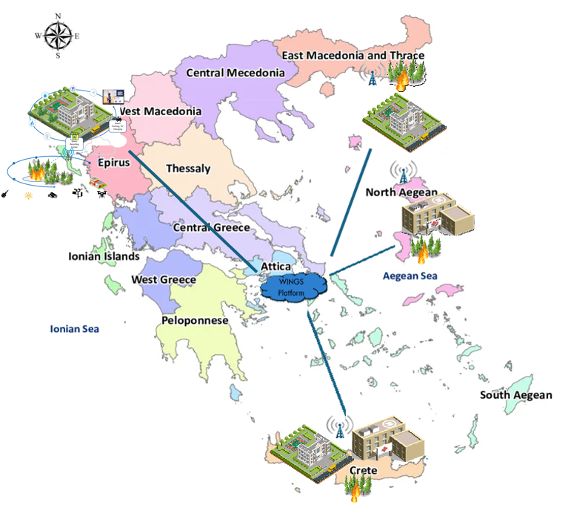
General description and context
The technological foundation of 5G-BRIDGE relies on a flexible, low-latency, and reliable 5G SA connectivity infrastructure, also leveraging complementary technologies when needed (optical, 5G small cells, Wi-Fi, etc.). The project will meet the needs of data-intensive applications and enable IoT-powered community services. Edge cloud integration and network slicing will ensure quality-of-service guarantees, while open, interoperable, and disaggregated technology solutions will contribute to the emergence of a robust European 3C network ecosystem. This approach is expected to drive investment in 5G and edge cloud technologies, supported by both public and private stakeholders, creating a positive spillover effect on digital skills, business transformation, and public services. By integrating devices, networks, and edge cloud capabilities, 5G-BRIDGE aims to create a ubiquitous mesh of computing and communication resources. These efforts will not only address immediate connectivity gaps but also establish Greece as a leader in 5G-enabled smart services. The project is fully aligned with the objectives of the CEF-DIG-2024-5GLSP call, ensuring long-term impact through scalable solutions and strategic collaboration. It aspires to demonstrate the benefits of virtualized, cloud-native network functions and telco edge cloud deployment, unlocking new opportunities for Greece’s key industries and setting the stage for the country’s digital transformation.
In Education, 5G-BRIDGE will enable Smart and Green Schools by introducing advanced digital tools such as augmented/virtual reality and AI-driven personalized learning. Rural and remote schools will benefit from more reliable distance education platforms, online labs, and high-performance collaboration tools. Learning spaces will be digitally equipped to support engaged and personalized teaching, while teachers will have the resources to integrate these tools effectively. School communities will gain digital platforms for communication and infrastructure monitoring of energy, water, recycling, and air quality, reducing the climate footprint. Use cases include immersive learning environments, remote STEM activities, smart energy and resource management, environmental monitoring, smart recycling, student engagement via AR, and digital school twins.
In Healthcare, 5G-BRIDGE supports high-quality telemedicine, remote diagnostics, drone-based rapid delivery of medical materials, and wearable health-monitoring systems, extending healthcare access particularly in rural and underserved areas. Real-time patient data can be transmitted via 5G-connected devices, while drones enable faster, safer transport of urgent or sensitive items across healthcare facilities, overcoming traffic and infrastructure challenges and improving patient outcomes.
In Civil Protection and Public Safety, 5G-BRIDGE enables real-time communication and data sharing to support faster decision-making and safer operations. Pilots will demonstrate urban drone services for delivering goods to vulnerable populations and patrolling for wildfire prevention, showcasing route optimization and service improvements while reducing risks compared to road transport. Fire protection use cases will integrate connected sensors, cameras, drones, and cloud-based AI for monitoring, early warnings, and forecasting. Dashboards and alert systems will provide actionable insights, enhancing efficiency and minimizing risks to first responders.
The strategic objective of 5G-BRIDGE is to facilitate the digital transformation of remote and underserved rural communities in mainland Greece and islands, leveraging advanced 5G SA connectivity capabilities to deliver digital healthcare, education, logistics support and civil protection services. This way the project is enhancing inclusion and reducing the digital gap by addressing communities in remote areas with low connectivity and limited or no access to digital tools and content.
To deploy specific 5G Stand Alone (5G-SA) network slices supporting specific remote regions in mainland Greece and islands, as well as the dense urban areas in the Municipality of Aigaleo, in Athens.
To enable and demonstrate in large scale advanced Education, Healthcare, Logistics and Civil protection domain SGIs across multiple (remote) regions in Greece (both islands and mainland), leveraging the new 5G SA infrastructure that will be implemented.
Support 5G best practices beacons in different sectors that can serve as templates for possible replication with other resources, national or EU (RRF, CEF DIGITAL, CEF TRANSPORT, CEF ENERGY).
Outreach to public audience, key stakeholders, dissemination, standardisation and further exploitation of the project’s main achievements
O1. To deploy specific 5G Stand Alone (5G-SA) network slices supporting specific remote regions in mainland Greece and islands, as well as the dense urban areas in the Municipality of Aigaleo, in Athens.
Through this objective 5G-BRIDGE will deliver as results:
- High-quality 5G SA (700 MHz, 2.6 GHz and 3.5 GHz) radio network upgrades in approximately 50 sites in these areas, towards increased capacity, low latency, increased reliability, and smooth network operation for the use cases.
- 5G SA Core network upgrades in terms of routing, storage, capacity and functionality features, required to offer the advanced servicesfor the project use cases. (D2.x, D3.x, D4.x)
- Connection of the upgraded 5G RAN and SA Core network with OTE Transport Network, as well as cloud and edge computing resources. (D2.x, D3.x, D4.x)
- Network management framework for performance monitoring, proactive/reactive fault management and anomaly detection, etc. (D2.x, D3.x, D4.x)
- Analysis of the key network-, service-, safety-, and security-level requirements of the envisioned use cases. (D2.1)
- Extended amount of measurement data (both on physical/lower layer as well as service-level) to provide statistical confidence and heterogeneity. Detailed analysis of the performance of the 5G deployed infrastructure under various configurations and for various realistic network load conditions and use cases. (D4.x, D5.2)
- Comprehensive documentation, comprising required deployment studies and relevant technical reports that will describe in detail the technical specifications of the newly deployed infrastructure. (D2.2, D3.x, D4.x)
O2 To enable and demonstrate in large scale advanced Education, Healthcare, Logistics and Civil protection domain SGIs across multiple (remote) regions in Greece (both islands and mainland), leveraging the new 5G SA infrastructure that will be implemented.
Through this objective 5G-BRIDGE will deliver as results:
- A fully operational framework, addressing the set of services to be showcased in the project. (D2.1, D5.1)
- Detailed service-level performance assessment and measurement data that will be collected during the piloting and use case validation activities. (D5.1, D5.2)
O3. Support 5G best practices beacons in different sectors that can serve as templates for possible replication with other resources, national or EU (RRF, CEF DIGITAL, CEF TRANSPORT, CEF ENERGY).
Through this objective 5G-BRIDGE will deliver as results:
- Trial methodology and measurements’ framework targeting the extensive validation of 5G network connectivity and the selected use case services and performance via field trials. (D2.1, D5.1)
- Comprehensive documentation comprising studies, technical reports describing the network planning, series of construction activities, use case set-up and execution, data collection and analyses, security analyses, etc. (D3.x, D4.x, D5.x)
O4. Outreach to public audience, key stakeholders, dissemination, standardisation and further exploitation of the project’s main achievements
Through this objective 5G-BRIDGE will deliver as results:
- Actions and initiatives which took place from members of the consortium in order to support, disseminate and exploit the key achievements. (D6.2, D6.3)
- An end-to-end, 5G-SA based Healthcare, Education, Logistics and Civil Protection services solution for further commercial exploitation beyond the project completion by project partners. (D5.x)
- Contribution to 5G Smart Communities relevant community activities. (D6.2, D6.3)